Sex Worker Search

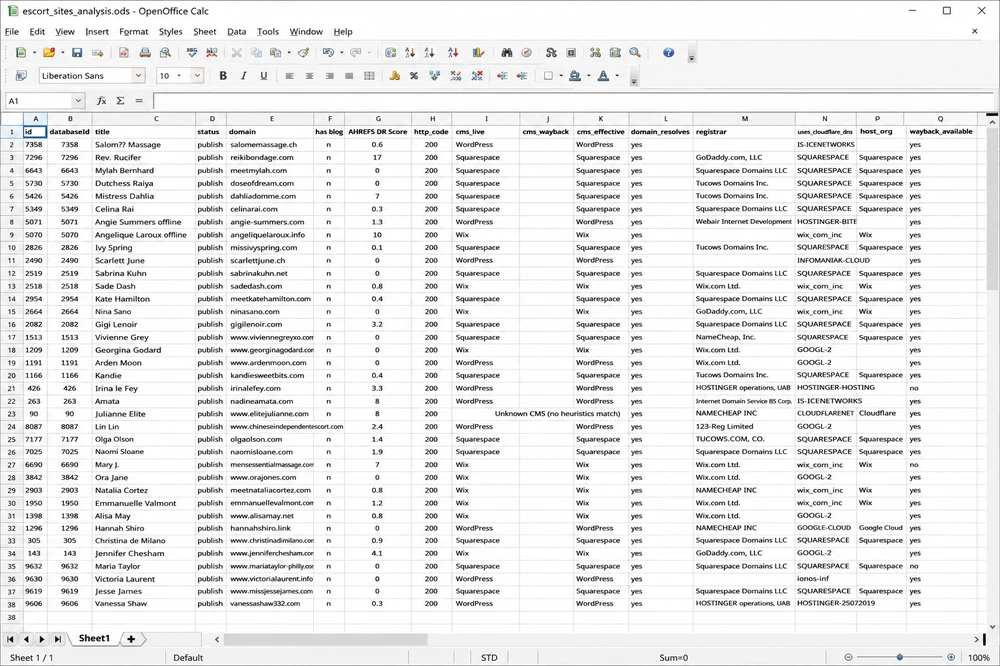
With help from the brilliant Josey from Lovesudo, I've recently run a script to determine for each of the 4607 sites indexed on Sex Worker Search their http code (200 online, 404 offline etc), the Content Management System (CMS) used to build the site, whether the domain resolves, the domain registrar (eg Namecheap, Godaddy etc), whether each site uses Cloudflare or not, hosting company, whether the site is archived on Wayback Machine,  if it is, the URL of the archive, and the timestamp of the most recent Wayback archive.

I've collected and analysed this data in hopes of drawing some conclusions as to what we can do to avoid our sites going prematurely offline and how to maximise the success of our personal websites in terms of SEO, search ranking and site visitors.

Offline Sites

Sex Worker Search is a search engine indexing the personal websites of independent providers.

Last month, in March 2026, I did a big tidy up removing all of the sites from the index that had gone offline in the past 4 years.

The first website indexed on Sex Worker Search was my site in April 2022.

Out of 4607 sites indexed between 2022 and 2026, 2,694 (58.5%), were still online.

1,913 (41.5%) were offline.

Nearly 2 in 5 sites are offline after 4 years.

From now on I'm going to do frequent, regular scans and remove offline sites.

The numbers of offline sites were way higher than I expected.

Based on the careers of my friends, acquaintances and duo partners, I had assumed that most sex workers who have built and maintained their own personal websites would stay in business on average for somewhere in the range of 5-10 years.

I was wrong. It seems to be way less than that. More like just a few years.

Lifespans of Sites

Sites indexed on Sex Worker Search are not brand new at the time of indexing but we can look at Wayback archives and measure the average lifespan of a SW website.

Wayback Machine shows the timestamp for the first recorded archive of a site and the most recent.

Currently my data just has the dates of the most recent timestamp but I'll see about running a script to get the first timestamp for each offline site and then we can estimate the average lifespan of a SW site.

Implications of a site going offline

A site going offline isn't necessarily a bad thing vs a site having greater longevity isn't always a good thing. eg the site might go offline because someone has reached their financial targets in the industry and happily retired or moved on to pursue other opportunities. A site might stay online when someone would prefer to retire and do something else but can't afford to leave sex work.

But I think there are choices we can make regarding our websites that improve our chances of running a successful and profitable sex work business and I hope looking at some statistics around the sites that have gone offline will reveal some outliers indicating design choices to avoid. eg CMS, site builders and hosting companies that may be banning us and taking our sites offline.

Average SW site lifespan compared to non SW sites

SW site lifespans are short.

Maybe not that short compared to the overall average lifespan of a website.

I'd like to find a study that's used a large dataset to calculate this.

I've looked at a variety of estimates saying 3 years, 5 years, 7 years etc but nothing that looks like an estimate from quantifiable data.

Reasons why a SW site might be offline

Quit/retired
Rebranded
Lost domains
Stopped paying hosting
Didn't renew SSL
On hiatus

Things to look at

CMS survival rates
Domain TLD survival (.com vs .ch vs .co.uk)
Cloudflare correlation
Hosting differences
Domain resolves vs HTTP fails

Offline rate by content management system CMS

Unknown 57.9%
Wix 35.7%
WordPress 33.8%
Squarespace 30.4%
Joomla 41.7%
Shopify 50% (tiny sample)

Wix, WordPress and Squarespace are all very similar in terms of offline rate. I was expecting to see WordPress dot org sites surviving longer in that Wix and Squarespace are site builders favoured by people less tech savvy and perhaps less invested in putting in the time and effort to build a WordPress site. It would make sense for Wix and Squarespace to be treated as more disposable.

SWS does not index site builder sites with the name of the sitebuilder in the domain name. If these were included, I'm sure WordPress sites, where someone has bought their own domain name, would have much greater longevity in comparison.

Shopify is unsurprisingly not popular and has a high offline rate. They're known to be anti sex work.

Host Count

Squarespace 855
Wix 545
Google (GOOGL-2) 303
Cloudflare 216
OVH / AT-88-Z 160
AWS 90
Infomaniak 69
Google Cloud 65
Hostinger 62
Euclid NL 49
Automattic (WP) 47
GoDaddy 42

Observations About Host Count

Squarespace & Wix are massively over-represented in this data set compared to the web overall.

According to Colorlib, Wix powers 4.3% of all websites and Squarespace powers 2.5% of all websites.

6.8% combined.

In my dataset, Wix + Squarespace combined host about 30% of SW websites.

These site builders are popular with non-technical users, solo operators and people who want a fast setup.

Via word of mouth recommendations, these site builders seem to get a lot of mentions in SW communities.

eg Mentions of Wix on the /r/sexworkers subreddit and mentions of Squarespace.

GoDaddy is under-represented.

only ~42 sites.

Whenever Godaddy gets mentioned by a SW in my experience, it's usually to say they're unethical, untrustworthy and anti SW so it's likely they're just not popular due to poor reputation in our community but it's also possible they are banning us.

In comparisons of Wix, Squarespace and WordPress dot org, sites like XposureCreative, Yellowball, and Polyspiral all rate WordPress dot org as the best for SEO.

Why not to use Wix or Squarespace site builders

Wix and Squarespace might be beginner friendly but you're then limited in terms of customisability and don't have access to powerful SEO tools available on wordpress like Yoast or Rank Math.

Also site builders, especially Wix, try hard to lock you in so if you decide later you want to move off their platform, they'll make that as difficult as possible for you.

WordPress dot com is anti sex work

Automattic, AKA WordPress dot com, (as opposed to WordPress dot org where you install your own instance of WordPress on your own hosting and are not bound by Automattic restrictions) is not popular with Sex Workers. Only 47 sites in my data set. This is consistent with the fact that WordPress dot com are anti sex work and well known for banning our sites.

Cloudflare Offline rate

Not using Cloudflare = 42.3% offline
Using Cloudflare = 19.9% offline

The rest are unknown as to whether they're using Cloudflare or not.

People not using Cloudflare are much more likely to have gone offline than those using it.

Interpretation

More technical users

Better domain/infra management

Better protection from hacks, hijacks and things that can break your site eg expired SSL.

Cloudflare isn't expensive but I guess anything that represents an ongoing cost is going to correlate with people who are more invested in their web presence.

Dead Domains vs Broken Sites

1,132 sites=domain dead
781 sites= domain alive but site broken

The main failure modes

1. Domain expiry / abandonment (majority)
2. Hosting/site breakage (minority)

Host Offline rate

Squarespace 17.8%
Wix 20.7%
Google (GOOGL) 19.1%
Cloudflare 19.9%
OVH / AT-88-Z 9.4%
AWS (AMAZO-4) 4.4%
Infomaniak 2.9%
Euclid NL 2.0%

1. Big platforms ≈ average churn
Wix / Squarespace / Google all ~18–21%
2. Smaller infra providers = much lower churn
AWS, Infomaniak, EU hosts = very stable

Interpretation

Look at the terms and conditions when choosing a hosting company. If they say they will ban you if you're a sex worker, don't use them. They may never notice you're breaking their rules and your site might survive on their hosting just fine but do we really want to give our money to platforms that are anti sex work?

Offline rates for different Top-Level Domains

.co.uk
Online = 64
Offline = 44
Total = 108

Offline rate = 44 / 108 = 40.7%

.ch
Online = 101
Offline = 63
Total = 164

Offline rate = 63 / 164 = 38.4%

.com
Online = 2358
Offline = 1315
Total = 3673

Offline rate = 1315 / 3673 = 35.8%

Interpretation

This was surprising. I thought I had a lot more dot co dot uk sites and I would have expected the .ch sites to have the lowest offline rate.

Overall, domain extension alone does not appear to be a strong predictor of website survival.

I'd still recommend dot ch.

.ch is Switzerland’s country-code TLD. Switzerland has historically had a relatively strong privacy culture, generally liberal laws around consensual adult services, strong data protection traditions, and a reputation for legal and financial stability. Because of this, some operators may perceive a .ch domain as a more privacy-conscious or security-oriented choice than more mainstream extensions like .com.

However, a .ch domain does not automatically place an entire website under Swiss law or provide absolute protection. Other factors still matter, including where the site is hosted, which registrar is used, which payment processors are involved, and the actual country where the operator is based and working.

As a result, a .ch domain is probably better understood as a branding signal, a privacy-conscious choice, or a mild jurisdictional preference rather than a guarantee of legal protection or long-term stability.

Ahrefs Domain Ranking (DR) scores of sites with a blog vs those without

I manually checked the Ahrefs Domain Ranking (DR) scores of 100 websites without a blog and 100 more sites with a blog to see if there was a significant difference.

There was a huge difference.

Group Approx Average Ahrefs DR
Sites without a blog ~3.3 DR
Sites with a blog ~9.2 DR

DR shows the strength of a website's backlink profile compared to the others in the Ahrefs database on a 100-point scale.

DR correlates with Google search ranking. So the higher the DR score, the better the chances of that site appearing on page 1 of Google for a given search term.

So the blog sites are averaging roughly:

nearly 3× higher DR
about +6 DR points higher overall

DR is logarithmic-ish in practice:

Moving from DR 1 → 9 is much easier than 40 → 48 but for small independent sites, DR 9 vs DR 3 is a huge visibility gap.

These results strongly suggest:

blogs attract backlinks
blogs create indexable pages
blogs generate long-tail search traffic
blogs encourage internal linking
blogs create reasons for other people to reference the site

Blogging correlates with:

higher effort
SEO awareness
long-term thinking
ongoing engagement with site

Conclusion regarding blogs

Independent provider sites with blogs tend to develop significantly stronger backlink authority than brochure-style sites.

Further Study of sites with vs without blogs

It would be interesting to also look at UR scores, numbers of backlinks and referring domains, organic keywords and organic traffic.

I don't want to name specific SW sites as examples unless I get consent from the owners but I will try reaching out to the owners of the sites I found with the best DR scores and do a separate post where I interview those people about what they've done with their sites overall, and specifically their blogs, that has resulted in such success with their domain ranking.

Cloudflare Surprisingly Unpopular

Only 166 sites out of my data set of 4608 sites are using Cloudflare as their DNS.

That’s only ~3.6% adoption.

According to W3techs, 22% of all sites use Cloudflare.

Why we should use Cloudflare

  • Protection against DDoS attacks and harassment
    Cloudflare helps protect sites from malicious traffic, attacks, and targeted attempts to take websites offline.
  • Hides the real server IP address
    Cloudflare acts as a reverse proxy, making it harder for attackers to discover and directly target the hosting server.
  • Improves website speed
    Its global CDN caches content closer to visitors, helping pages and images load faster worldwide.
  • Free HTTPS/SSL security
    Cloudflare makes it easy to secure a site with HTTPS encryption, improving visitor trust and helping SEO.
  • Bot, spam, and scraper protection
    Cloudflare can block spam bots, scrapers, fake traffic, and abusive automated requests that commonly target independent websites.

No SSL

There are 1148 sites with no http code that are offline. When I manually check them, in most cases chrome just refuses to open the site because it doesn't have a valid SSL certificate.

No https

Does this mean a common cause of SW sites being offline is people who never set up https or just don't know how to keep their SSL certificates up to date?

This was surprising. Most site builders do this automatically.

Cloudflare does it automatically.

Or it just means they've retired and stopped paying for whatever was renewing their SSL?

Hijacked Domains

I used URL opener to double check the sites the script marked as offline 50 at a time and tabbed through them to see if they're really offline.

I noticed a lot of the domains had been hijacked by various scammers, spammers, online casinos etc.

A lot of them were SEO spam farms consisting of random keyword content, AI-generated garbage and affiliate links.

Domain squatting happens when a site goes offline, eg when a sex worker retires and stops paying their domain registration fee, and a bot detects an available domain for a site with some value.

The value comes from existing backlinks, bookmarks, and sites still appearing in Google search results.

Squatters then publish some spam under that domain name and parasitise the residual value built by the domain's original owner.

How to avoid domain name hijack

I recommend leaving your site online for a year or so after you retire with all your pictures and content removed and just a brief "I've retired" message.

Over the course of time, your backlinks will drop off, Google will forget you and any regular clients who had your site bookmarked will have realised you've retired and stopped visiting your site.

Then when you do let your domain expire, it won't have enough retained value to be targeted by squatters.

Recommendations based on stats

Don't use sitebuilders like Wix or Squarespace.

You especially don't want a sitebuilder site with the name of the sitebuilder in the domain name. It looks unprofessional and leaves you with no scope to improve your search ranking.

Buy your own domain name and pay for hosting otherwise you're subject to the rules of the site builder and most of them are anti sex work and known to take our sites offline.

Use WordPress dot org.

Don't use WordPress dot com.

Choose hosting that's not anti sex work.

Use dot ch for your TLD.

Use Cloudflare for DNS.

Or at least make sure you have something in place that automatically keeps your SSL certificate up to date.

Leave your site online for a year or so after you retire with an "I've retired" message to discourage domain name squatters.

Have a blog page on your site and regularly post quality written content on your blog using Yoast or RankMath or similar to format your posts for best SEO outcomes. Make sure your writing is engaging, compelling, entertaining so that real humans will read from start to finish.